Showing posts with label Mistakes. Show all posts

Friday, May 7, 2010

Abs Mistakes


THE GREAT ABS MISTAKE
"He Was Doing One Thousand Crunches


"1,000 Sit-Ups And Crunches A Day and Still No Abs!" One question I received recently REALLY got my attention because a young guy told me he was doing 1,000 crunches and sit ups a day and said he still couldn’t see his abdominals. He wrote: “Tom: I have been working out for around a year now and I cannot get my lower abs into any type of shape. I'm starting to see my upper abs a little bit, which is great, but despite doing 900 various crunches, ab roller, and 100 sit-ups four days a week, along with my regular workout on the weights, I still have a tire around my waist. What else can I do?” What did I tell him? Well, I gave him the same answer I’ve given thousands of people over the years, which is the only true “Secret” to great abs... It takes training to increase strength, build endurance and DEVELOP the abdominals, but to SEE the definition in your abdominals - or any other muscle group for that matter - is almost entirely the result of low body fat levels. This may sound counter-intuitive, but if you can't see your abs, it's not an issue of “muscle development” at all. YOU ALREADY HAVE A 6-PACK! If you can't see it, you simply have too much body fat covering up the ab muscles. The lower abdominal area also happens to be the one place that most people - especially men - store the body fat first. There's a Scientific Reason Why Your
Lower Ab Flab Is The Last Place To Go Most people don't have their fat distributed evenly throughout their bodies. Each of us inherits a genetically determined and hormonally-influenced pattern of fat storage just as we inherit our eye or hair color. In other words, the fat seems to "stick" to certain areas more than others. There's a scientific reason for this. Your fat cells are not just inert "storage tanks" for excess fuel. They are actually endocrine glands which send and receive signals from the rest of the body. You could say that your fat cells "talk to your body" and your body "talks to your fat cells." This occurs through a hormone and receptor system. For body fat loss to occur, you must first get the fat cell (adipocyte) to release the fat into the bloodstream. THEN, the free fatty acids must be delivered to the working muscles where they are burned for energy. For fat to be released, the hormone adrenaline (epinephrine) must be secreted and send a signal to your fat cells. Your fat cells receive this hormonal signal via adrenaline receptors called adrenoreceptors. Fat cells have Beta 1 (B1) and Alpha 2 (A2) receptors. B1 receptors are the good guys. They activate hormone sensitive lipase, the enzyme that breaks down the fat and allows it to be released into the bloodstream to be burned. A2 receptors are the bad guys. They block the fat-releasing enzymes in the fat cell and encourage body fat formation. How Body Fat Storage Patterns Affect You
And Keep Your Abs From Showing What's the point of all the physiology? Well, it turns out that in men, the lower abdominal region has a higher concentration of A2 receptors, so this gives us one possible explanation of why the lower abdominal region is often the first place the fat goes when you gain it, and the last place it comes off when you're losing it. (Incidentally, the fat in women's hips and thighs is also higher in A2 receptors). This situation is dictated by genetics and by the hormonal and enzymatic pathways we discussed. Think of ab fat like the deep end of the swimming pool. No matter how much you protest, there is no way you can drain the deep end before the shallow end. However, don't let this discourage you. Lower ab fat WILL come off, it will simply be the last place to come off. First place on - Last place off (Remember, F.O.L.O.!) This helps to explain why abdominal exercises have little impact on body fat loss. It's a huge mistake to think that hundreds or thousands of reps of ab exercises will remove lower abdominal fat, except to the degree that it burns calories and contributes to the calorie deficit. What removes the fat - all over your body - is a calorie deficit and that comes from decreasing food intake, increasing activity, or a combination of both. What I suggested to this young man was cutting back the ab training, spending the time he was wasting on excess ab exercises for more intense, calorie-burning cardio and weight training for the rest of the body. I also suggested he do an accounting of his food intake, get his nutrition in order and decrease his calories slightly if necessary. As it turned out, his diet was a mess, and as nutrition experts like to say, "You can’t out-train a lousy diet." It's a monumental error to think that 1,000 reps of ab work a day will make your abs finally "pop" when your diet is a disaster and that's leading to fat storage. It’s not that ab exercises aren’t important. But all the ab exercises in the world won't help as long as you still have body fat covering the muscles. You can't "spot reduce" with abdominal exercise and YOU CAN'T SEE YOUR ABS THROUGH A LAYER OF BODY FAT!

Wednesday, February 10, 2010

Common Gym Mistakes

Go to fullsize image


Mistake 1: Barbell Squat

The Mistake

The first mistake people make when performing squats is not keeping their knees over their toes as they lower down into the squat position. The most common path is for the knees to begin moving inwards so they are in more of a 'knock-kneed' position.

Rarely you will also see people performing the opposite, with their knees moving in the outwards direction; however this usually happens only when the individual is bowl-legged to begin with or has a very natural turnout ability (feet naturally point outward like a dancer's).

When the knees follow this path, it places much more stress on the ligaments and connective tissues holding the knee cap and will often result in a great deal of pain within the knee joint.

To prevent this from happening, it is best to perform your squats in front of a mirror so you can watch and precisely track where the knee joint is moving.

RELATED ARTICLE


[
Click here to learn more. ]

Author:
Randy Herring

If you see them moving slightly out of alignment, correct their tracking before going down any further. If it is a problem that is happening repeatedly, chances are that you may be lifting too heavy of a weight and simply lightening your load will correct the problem.


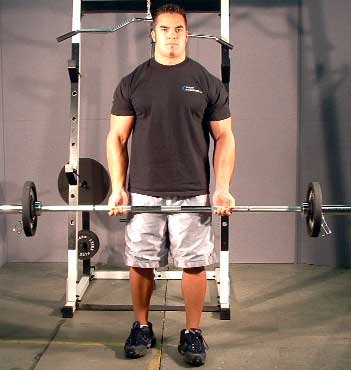
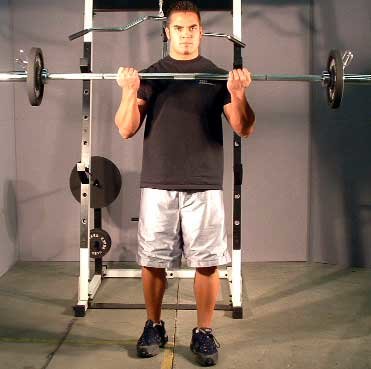
Mistake 2: Barbell Curls

The Mistake

This is usually seen when guys are trying to hoist a very heavy weight that is not within their ability. They will start curling the weight up and finish by using the momentum of their upper body to fully curl the bar to the finish point.


Click Image To Enlarge.
Barbell Curl.

Video Guides: Windows Media - RealPlayer

When this occurs, a great deal of stress is placed on the lower back and shoulder joints, as it is no longer the muscles that are pulling the weight up, but the speed of the movement.

The thinking behind this is that by using a heavier weight you will help to further push your muscles (after all, muscle growth is the result of overload); however, when the weight gets too high and this begins happening, the biceps aren't really even working anymore so no positive benefits will result.

The Solution

To correct this problem, first lighten the amount you are lifting. This is the primary cause of this issue to begin with. After you have done that, really concentrate on keeping your elbows locked against the side of your body during the movement.

RELATED ARTICLE


[
Click here to learn more. ]

Bicep Tendon Injuries!
Learn from the following details on what those injuries are, some of the best ways to identify, and how best to deal with them.

Author:
Dr. David Ryan

This will prevent you from swinging the weight up as if you were to use the swinging motion the elbows would also begin to move upwards.

A better way to achieve results with this exercise is through a slow and controlled motion, so focus on resisting the tension on both the way up and the way down, and I promise you will see much greater changes in your arm than if you performing the swinging motion that was going on before.


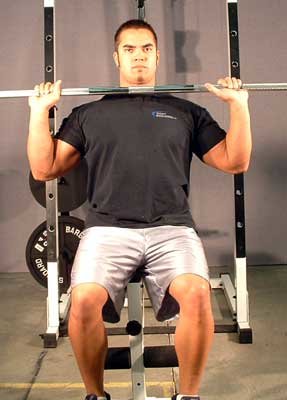
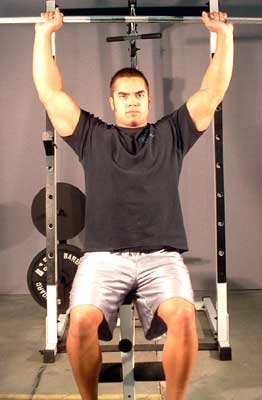
Mistake 3: Military Press

The Mistake

What happens is they begin with good form, lifting the weight just above their head, but then as they continue to push upwards they begin to sway their backs forming a wonderful U-shape in their lumbar region. This is a perfect recipe for lower back pain.


Click Image To Enlarge.
Military Press.

Video Guides: Windows Media - MPEG - Video iPod

With that heavy weight above your head and gravity acting down on it the weight is multiplied and the force gets focused on your lower back vertebrae. And since the spine is in an unnatural curvature the pressure loaded on these vertebrae will not be supported and can lead to a great deal of problems.

The Solution

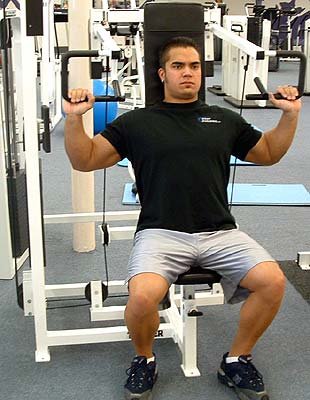
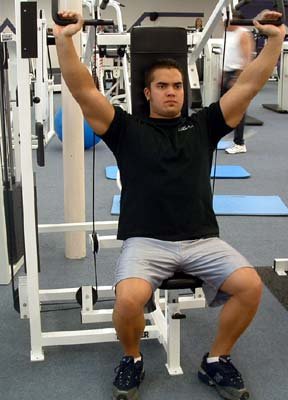
The simplest way to correct this problem is simply to use a military press machine with a back rest. This will help you to keep your back straight while performing the exercise (note that it is still possible for individuals to begin to sway in this machine as well so you will still have to concentrate on keeping your back tight against the back rest).


Click Image To Enlarge.
Machine Shoulder Press.

Video Guides: Windows Media - MPEG - Video iPod

If you prefer not to use a machine to ensure you maintain proper form then try using less weight and perform the exercise standing sideways in front of a mirror. As you lift the weight, watch in the mirror and see what your back does.

YPES OF INJURIES

  1. Tendonitis: Inflammation of the tendon connecting muscle to bone.
  2. Strain: Over-stretch/over-use of a muscle.
  3. Sprain: Over-stretching a ligament connecting two bones.
  4. Bursitis: Inflammation of the bursa sack which serves as padding between a muscle and a bony prominence.
  5. Avulsion: Complete tearing of a muscle. Typically along the junction between the muscle and its tendon.
  6. Contusion: Bruising caused by impact.
  7. Fracture: Breakage of a bone. Can be complete, partial, or from compression.

COMMON

  1. Tear: Injury resulting from avulsion/tearing of the tendon connecting the Pectoralis Major to the humerous. Most often seen in people who overuse anabolic steroids (discussed later). A minor tear will be painful and may demonstrate minimal bruising. A major tear will result in a balling of the muscle towards the sternum with a significant amount of bruising.
  2. Elbow Tendonitis:
    • Triceps Tendonitis: Pain along the tendon of the triceps connecting into the pointed part of the elbow. Resulting from overuse.
    • Lateral Epicondylitis / Tennis Elbow: Pain along the lateral epicondyle (outer bone on the upper portion of the forearm). Results from strain placed along the origin of the extensor muscles of the forearm. Can ultimately result in tearing of these muscles.
    • Medial Epicondylitis/ Golfer's Elbow: Pain at the medial epicondyle (inner bone on the upper portion of the forearm). Due to overuse of the flexor muscles of the wrist usually indicated by pain with gripping weights.
  1. Back Strain/Sprain: Indicated by pain at center of lower back, along top of gluteal muscles, or along paraspinal muscles. Usually resulting from lifting too much weight or using poor form during squats or deadlifts.
  2. Knee Strain/Sprain: Various injuries include meniscal tears, patellar tendonitis, ACL tears, bursitis. Will be indicated by pain along the joint line of the knee, behind the knee joint, or just below the knee cap along the patellar tendon.
  3. Delayed Onset Muscle Soreness: Soreness in a muscle that has been worked. Typically occurs within 24-48 hours and should be gone within 72 hours. Resulting from build up of cortisol, lactic acid, or micro tears in the muscle.